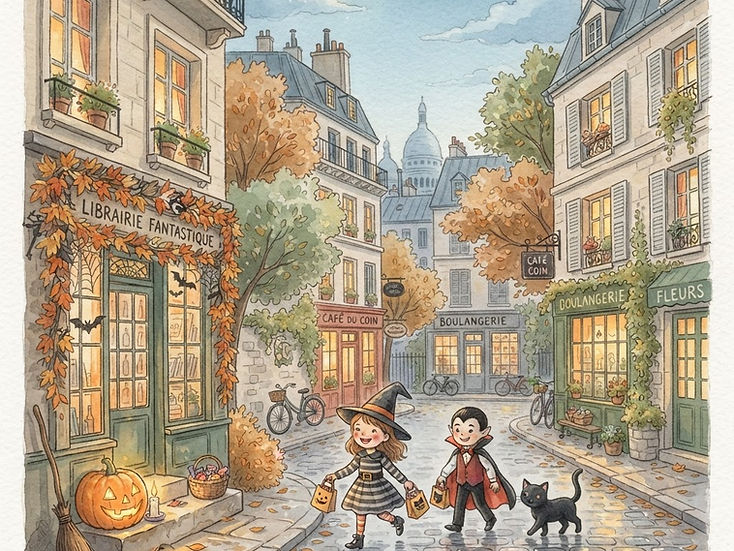
Celebrating Halloween in France: the real story (and how the French do it now)
Where Halloween actually comes from
Halloween feels all-American, but its roots are Celtic and Catholic. The word itself is a contraction of All Hallows' Evening, the night before All Saints' Day (la Toussaint, November 1st), a public holiday in France.
Long before pumpkins, the Celtic festival of Samhain marked the end of summer and the start of the dark half of the year. People believed the boundary between the living and the dead thinned on this night, so they lit bonfires and wore costumes to confuse wandering spirits. When Christianity spread, the Church folded those customs into All Saints' Day and All Souls' Day (November 2nd).
So the bones of Halloween are European. The modern Halloween, with its trick-or-treating, costumes and plastic pumpkins, is the American version, re-exported back across the Atlantic.
When did Halloween arrive in France?
Surprisingly late. For most of the 20th century, France ignored Halloween. It landed in the mid-1990s, pushed by a mix of American TV, Coca-Cola marketing and a famous 1997 campaign by a telecom company that invited people to dress up.
It never fully settled in. There is no school holiday around it (la Toussaint is November 1st, but the week off is for All Saints, not Halloween), and many older French people see Halloween as a commercial American import that competes with their own traditions.
Still, every year it gets a little more visible, especially among young adults and families in big cities.
What Halloween looks like in France today
Here is the honest picture of a French Halloween:
- Costume parties, not kids at doors. Trick-or-treating exists but is thin. The heart of Halloween in France is adults and students at house parties and bars, dressed up.
- Shops lean in hard. Supermarkets decorate aisles with pumpkins, sweets and costumes from early October. The commercial side is the most visible part.
- A few cities embrace it. Paris (especially the Marais and Disneyland Paris), and cities with student populations hold events. Small towns often do nothing.
- La Toussaint is the bigger deal. November 1st, the day after, families visit cemeteries and place chrysanthemums on graves. This is the celebration that actually belongs to France.
So if you are in France on October 31st, expect some decorated shop windows, a few costumed parties and not much else. It is quieter than you might guess.
The French words you need for Halloween
A short list to talk about the holiday with a French person:
- la Toussaint, All Saints' Day (November 1st, a public holiday)
- le jour des morts, All Souls' Day (November 2nd)
- une citrouille, a pumpkin
- un déguisement, a costume
- se déguiser, to dress up (e.g. Je me déguise en sorcière)
- une sorcière, a witch
- un fantôme, a ghost
- des bonbons, sweets or candy
- « Des bonbons ou un sort ! », the French try at "trick or treat" (literally: sweets or a spell)
- faire peur, to scare (e.g. Ce film me fait peur)
Should you celebrate Halloween if you are learning French?
Yes, not because France goes big on it, but because it is a perfect low-pressure topic to practice. Holidays give you ready-made vocabulary, a story to tell and an easy way into small talk.
Try this: describe, in French, how Halloween is celebrated in your country. Use the words above. Then ask a French person whether they celebrate it. You will get an opinion, and opinions are gold for conversation practice.
And remember the cultural flip: if you want the celebration that matters in France, look at la Toussaint and the chrysanthemums on the graves. That is the French autumn ritual, quiet and family-centered, sitting right next to the imported pumpkins.
Ready to start your journey?
Explore our 12-month group program, online and in-person.
See the program